The Mythology of your Star Sign
The gods wrote your star sign in blood, love, and starlight. Twelve constellations, twelve myths, and the famous Italians and French who were born under each one.





The Mythology of Your Star Sign: Ancient Stories Written in the Stars
The English word zodiac comes from the Greek zōidiakòs kýklos — the "circle of little animals." It's a fitting name. Look up at the night sky, and you're staring at the same constellations that ancient Babylonians, Greeks, and Romans mapped thousands of years ago, populating the darkness with rams, bulls, lions, crabs, and fish. Each one carries a myth. And most of those myths are far stranger, bloodier, and more beautiful than your daily horoscope would ever suggest.
The Romans inherited much of their astrology from the Greeks, who inherited it from the Babylonians, who were reading the sky long before anyone built the Colosseum or carved the first marble god. But it was in the Greco-Roman world that these constellations found their richest stories — tales of jealousy, transformation, sacrifice, and love so intense it bent the laws of mortality.
Here's the story behind every sign — and where their echoes still live in Italy and France today.
Aries — The Ram (March 21 – April 20)
The ram of Aries is no ordinary animal. It's the legendary creature with the Golden Fleece, the same treasure that launched Jason and the Argonauts on one of mythology's greatest voyages.
The story begins with treachery. Phrixus and Helle, two royal children, were condemned to death by their jealous stepmother Ino, who had manipulated an oracle to demand their sacrifice. But the gods intervened. A magnificent ram with fleece of pure gold descended from the sky and carried the children away on its back. Helle, tragically, lost her grip and fell into the sea — the stretch of water where she drowned was named the Hellespont in her memory (modern-day Dardanelles).
Phrixus survived, reached the kingdom of Colchis on the Black Sea coast, and sacrificed the ram in gratitude to Zeus. He presented the Golden Fleece to King Aeëtes, who hung it in a sacred grove guarded by a dragon that never slept. There it remained until Jason arrived with his crew of heroes aboard the Argo, aided by the sorceress Medea, who drugged the dragon and helped Jason seize the fleece. The two fled together, and the Golden Fleece was spread upon their bridal couch — a symbol of divine union and royal legitimacy.
Ancient Mediterranean civilizations immortalized the ram among the stars, and to this day Aries opens the zodiac — the sign of beginnings, courage, and headstrong ambition.
Notable Aries
Raphael Sanzio (March 28, 1483)

With our Vatican Museums, Raphael Rooms and Sistine Chapel Private Tour you'll be able to see Raphael's masterpieces.
Raphael Sanzio (March 28, 1483), the Renaissance master whose frescoes still glow inside the Vatican Museums — from the Stanze di Raffaello to the Transfiguration.
Pope Urban VIII (April 5, 1568)
Pope Urban VIII (April 5, 1568), the Barberini pope who transformed Rome's skyline and commissioned Bernini's Baldacchino inside St. Peter's Basilica.
Taurus — The Bull (April 21 – May 20)
The mythology of Taurus is one of the most layered in the entire zodiac — a story that begins with desire, spirals into deception, and ends with a monster in a labyrinth.
Zeus, king of the gods, became infatuated with Europa, a Phoenician princess. Rather than approach her directly — a strategy that rarely ended well for the women involved — he transformed himself into a magnificent white bull and wandered into the field where Europa was picking flowers. The bull was so beautiful and docile that she couldn't resist petting it. She climbed onto its back. The moment she did, Zeus plunged into the sea and carried her across the water to Crete, where she bore him a son: Minos, who would become the island's legendary king.
But the story doesn't stop there. Minos, seeking dominion over the seas, made a deal with Poseidon: the god would grant him naval supremacy in exchange for a white bull to be sacrificed in his honor. Poseidon delivered. Minos, however, found the bull so beautiful that he kept it, offering a lesser animal instead. The god's revenge was surgical and grotesque. He called upon Aphrodite, who cursed Minos's wife Pasiphaë with an uncontrollable desire for the white bull. The offspring of that union was the Minotaur — half man, half bull, a creature that fed on human flesh.
Minos imprisoned the Minotaur in the Labyrinth, an impenetrable maze designed by the architect Daedalus. Athenian youths were sent inside as sacrificial offerings, until Theseus, prince of Athens, volunteered to end the horror. With the help of Minos's own daughter Ariadne and her ball of thread, Theseus entered the maze, killed the Minotaur with a club, and followed the thread back to freedom.
The white bull was placed among the stars — a constellation of beauty, stubbornness, and the dangerous consequences of broken promises.
Notable Taurus
William Shakespeare (April 23, 1564)
William Shakespeare (April 23, 1564), whose influence on Western literature needs no introduction, and whose Globe Theatre has a faithful replica in Rome, Villa Borghese.
Niccolò Machiavelli (May 3, 1469)

Book a Florence Private Walking Tour to see Palazzo Vecchio with your own eyes!
Niccolò Machiavelli (May 3, 1469), the Florentine diplomat whose name became a byword for political cunning, born in the shadow of the Palazzo Vecchio.
Salvador Dalí (May 11, 1904)
Salvador Dalí (May 11, 1904), the surrealist visionary who spent formative years in Paris, exhibited alongside the avant-garde that defined 20th-century art.
Gemini — The Twins (May 21 – June 21)
The myth of Gemini is, at its core, a love story between brothers — one mortal, one immortal — and the grief that shattered the boundary between life and death.
Castor and Pollux were twins born to the same mother, Leda, but fathered by different beings. Castor's father was Tyndareus, king of Sparta — a mortal man. Pollux's father was Zeus, who had seduced Leda in the form of a swan. The twins were identical in appearance and inseparable in life. They sailed with Jason as Argonauts, fought side by side in the Trojan War, and became legendary horsemen and warriors.
But the one thing they couldn't share was mortality. Castor was human. Pollux was divine.
When Castor was killed in battle, Pollux was devastated. He begged Zeus to let him die alongside his brother. Zeus, moved by the depth of his son's love, offered a compromise: the twins would spend alternating days between Olympus and the Underworld, forever together but never entirely in one realm. Eventually, Zeus honored them both by placing them in the sky as the constellation Gemini — two stars, side by side, for eternity.
It's one of the most tender myths in the entire Greek canon. In a mythology defined by jealousy, punishment, and divine cruelty, Gemini is the rare story that ends in grace.
Notable Geminis
Dante Alighieri (between May 22 and June 13, 1265)
Dante Alighieri (between May 22 and June 13, 1265), the Florentine exile who wrote the Divine Comedy and, in doing so, invented the Italian language. His journey through Hell, Purgatory, and Paradise begins in Rome and reaches across the entire medieval cosmos.
Paul Gauguin (June 7, 1848)

During one of our Orsay Museum Private Tour, a dedicated private tour guide will tell you everything you need to know about Gaugin.
Paul Gauguin (June 7, 1848), born in Paris, who abandoned the Parisian bourgeoisie for the South Seas and painted a world European art had never seen.
Cancer — The Crab (June 22 – July 22)
Of all the zodiac myths, Cancer's might be the most heartbreaking — a story of blind loyalty rewarded with a crushing death and a dim constellation.
The crab enters mythology during the Twelve Labors of Hercules, specifically the second labor: the slaying of the Hydra, the many-headed sea monster that lurked in the marshes of Lerna. Hera, queen of the gods and Hercules' lifelong enemy, watched the battle with mounting fury. Hercules was winning. She needed a distraction.
She summoned a giant crab named Carcinus and commanded it to attack the hero from below. The crab obeyed without hesitation, scuttling from the marsh and clamping its claws onto Hercules' foot. It was a brave act — and a futile one. Hercules barely broke stride. He crushed the crab beneath his heel and returned to his fight with the Hydra.
Hera, moved by the crab's unquestioning loyalty and courage, placed it among the stars. But because the crab had ultimately failed in its mission, its constellation was given no bright stars. Cancer is the dimmest sign in the zodiac — a fitting tribute to a creature that gave everything and achieved nothing, honored not for its success but for its devotion.
Some scholars believe Cancer was added to the Hercules myth retroactively, specifically to fill the gap between Gemini and Leo and complete the twelve-sign zodiac. Even so, the story resonates: sometimes the most loyal acts are the most invisible ones.
Notable Cancers
Julius Caesar (July 13, 102 BCE)
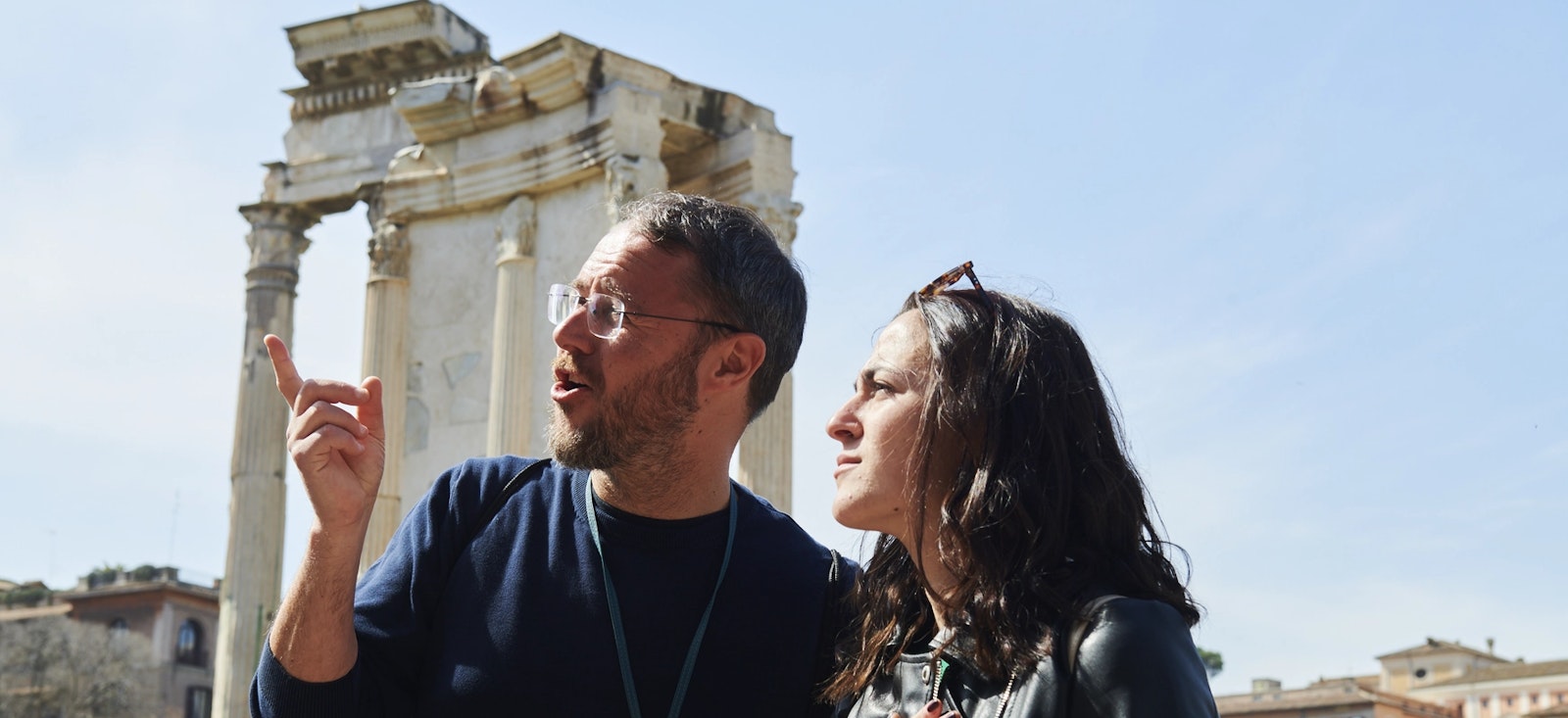
Our private guide Simone, at the Roman Forum, during a private tour focused on Julius Caesar.
Julius Caesar (July 13, 102 BCE), the Roman general and dictator whose name echoes across the Roman Forum, the Curia, and the very calendar we use today — the month of July is named after him.
Henry VIII (June 28, 1491)
Henry VIII (June 28, 1491), the English king who reshaped European politics by breaking with Rome — his conflict with the papacy is still visible in the art and architecture of the Vatican.
Leo — The Lion (July 23 – August 22)
The lion of Leo is the Nemean Lion, one of the most terrifying creatures in Greek mythology — and the first of Hercules' twelve impossible tasks.
The Nemean Lion was no ordinary predator. Its parentage varies by source — some say it was the offspring of Typhon and Echidna, others claim it fell from the moon, born of Zeus and Selene. Whatever its origin, the beast was unique in one devastating respect: its golden fur was impenetrable. No blade could cut it. No arrow could pierce it. No weapon forged by mortal hands could do it harm.
The lion terrorized the city of Nemea, slaughtering livestock and dragging humans into its cave, which had two entrances — one for ambush, one for escape. When Hercules arrived, he first tried his arrows, which bounced off the lion's hide. He tried his sword, which bent on impact. Understanding that no weapon would work, Hercules blocked one entrance to the cave with boulders, entered through the other, and strangled the lion with his bare hands.
The aftermath was almost as remarkable as the fight. Hercules tried to skin the lion with his knife and failed — the hide was as impervious in death as in life. It was the goddess Athena who whispered the solution: use the lion's own claws. Hercules did, and from that day forward wore the Nemean Lion's pelt as armor — the most recognizable attribute in all of Greek art.
Zeus placed the lion among the stars as the constellation Leo, a permanent monument to the beast that was so powerful only the strongest man alive could kill it, and even he couldn't do it with a weapon.
Notable Leos
Napoleon Bonaparte (August 15, 1769)
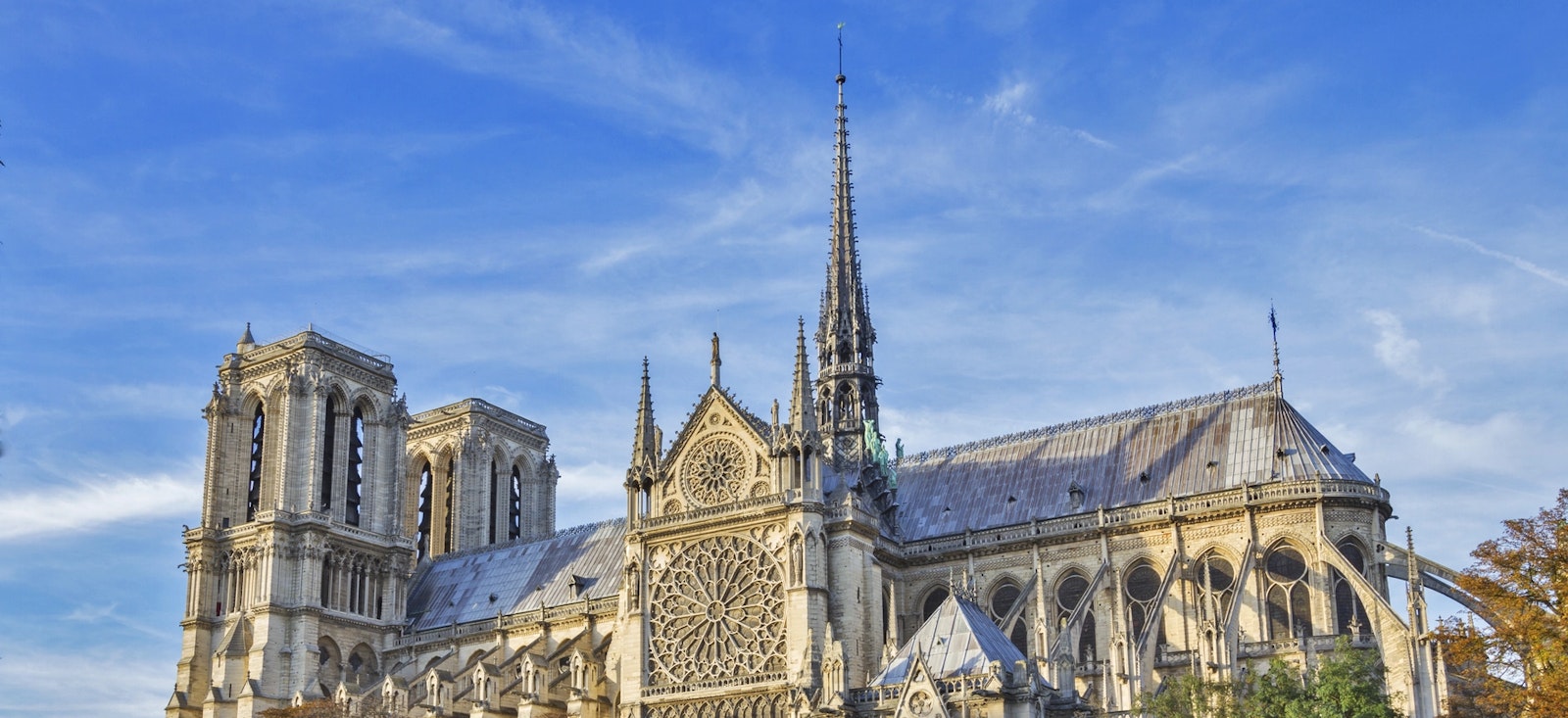
Notre-Dame de Paris is part of our Île de la Cité Private Walking Touritinerary.
Napoleon Bonaparte (August 15, 1769), born in Corsica, crowned emperor in Notre-Dame de Paris, and buried beneath the golden dome of Les Invalides — his legacy reshaped France, Europe, and the modern world.
Giorgio Vasari (July 30, 1511)
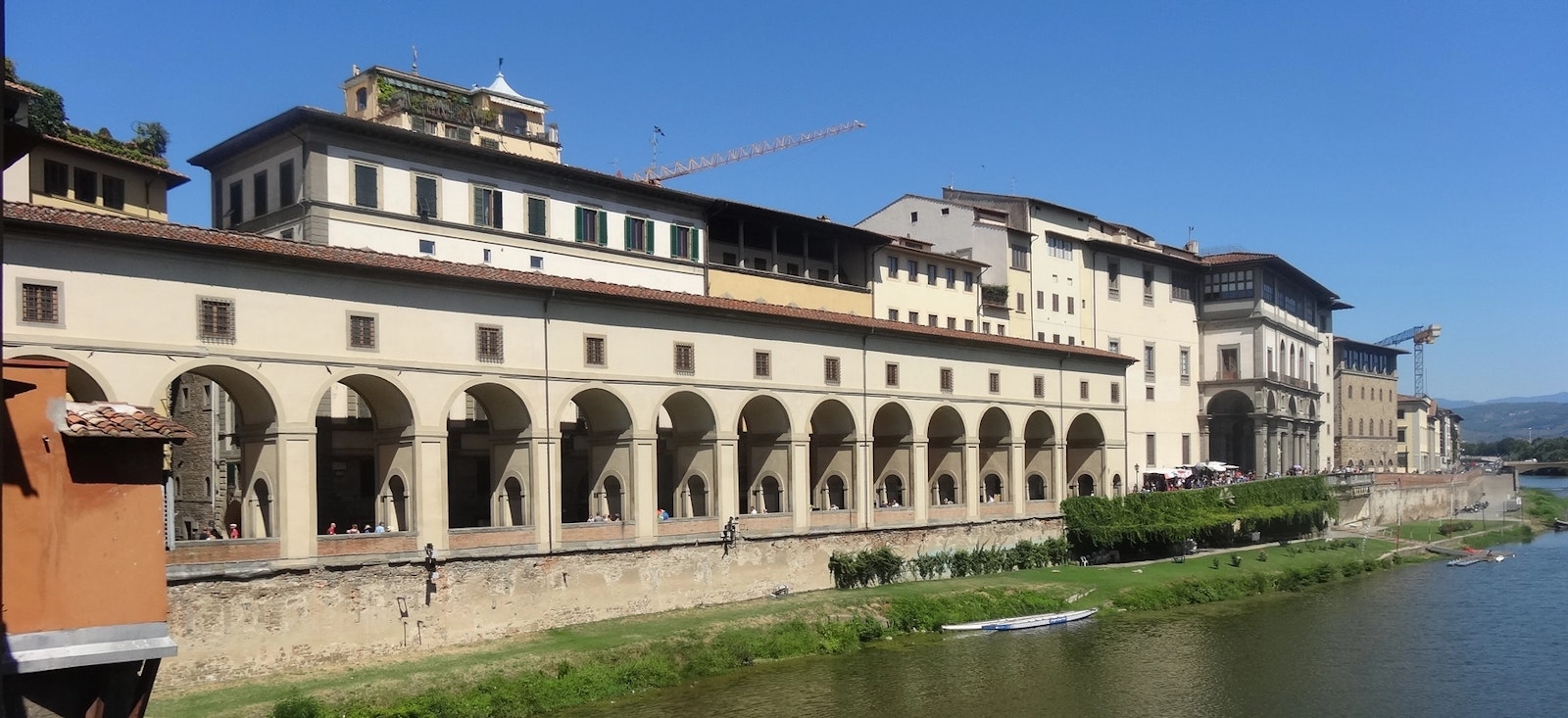
Walk through centuries of history with our Uffizi Gallery and Corridoio Vasariano Private Tour.
Giorgio Vasari (July 30, 1511), the Italian painter, architect, and author of The Lives of the Artists, a book that essentially invented art history, and whose Corridoio still connects the Uffizi to the Palazzo Pitti in Florence.
Virgo — The Maiden (August 23 – September 22)
Virgo is the only female figure in the zodiac, and her mythology draws from some of the most powerful goddesses in the ancient world — Demeter, Ceres, Isis, Ishtar. All of them share a common thread: fertility, harvest, and the cyclical death and rebirth of the natural world.
The most enduring myth attached to Virgo is the story of Persephone. The young goddess of spring was gathering flowers in a meadow when Hades, god of the Underworld, erupted from the earth and dragged her below. Her mother Demeter, goddess of the harvest, was shattered. In her grief, she refused to let anything grow. Crops withered. Fields turned to dust. Famine spread across the earth.
Zeus intervened, ordering Hades to release Persephone. But there was a condition — anyone who ate food in the Underworld was bound to stay. Persephone had eaten six pomegranate seeds. The compromise was elegant and brutal: she would spend six months of each year above ground with her mother, and six months below with Hades. When Persephone is above, the earth blooms. When she descends, winter comes.
The constellation Virgo is visible from March through August — precisely the months of growth and harvest, when Persephone walks the earth.
There's another figure often associated with Virgo: Astraea, the goddess of justice. She was the last of the immortals to leave Earth during the decline of the Golden Age, when humanity descended into violence and corruption. After departing, she was placed among the stars as Virgo, and her scales of justice became the neighboring constellation Libra. She is the virgin who judged humanity — and found it wanting.
Notable Virgos
Caligula (August 31, 12 CE)

Our private local tour guide Pamela during one of her Colosseum Arena, Roman Forum and Palatine Hill Private Tour.
Caligula (August 31, 12 CE), the Roman emperor whose brief, chaotic reign left a mark on the Palatine Hill and the Roman imagination.
Renzo Piano (September 14, 1937)
Renzo Piano (September 14, 1937), the Italian architect who designed the Centre Pompidou in Paris, a building that shocked the city and redefined what a museum could be.
Libra — The Scales (September 23 – October 23)
Libra stands alone in the zodiac. It's the only sign represented by an inanimate object — the Scales of Justice — rather than a living creature or mythological character. And that distinction tells you everything about what Libra means.
The scales belong to Themis, the Greek personification of divine law, custom, and natural order. She was a Titaness — older than the Olympian gods — and served as Zeus's counselor on matters of justice and morality. She is the figure behind every modern depiction of Lady Justice: blindfolded, balanced, impartial.
Her daughter Astraea carried the scales among mortals during the mythical Golden Age, when gods and humans lived together and justice was effortless. As humanity corrupted itself through successive ages — Silver, Bronze, Iron — the gods abandoned Earth one by one. Astraea held on the longest, the last immortal to walk among us, desperately trying to preserve fairness in a world that no longer wanted it. When she finally left, heartbroken, she took her scales with her. Zeus placed her in the sky as Virgo, and the scales beside her as Libra.
Libra's mythology is quieter than most zodiac stories. There's no monster, no hero, no violent climax. Instead, there's an absence — the departure of justice from the human world — and a reminder, written in stars, of what we lost.
Notable Libras
Caravaggio (September 29, 1571)
Caravaggio (September 29, 1571), the Italian painter who reinvented light and shadow, whose masterpieces hang in Roman churches you can still walk into today — San Luigi dei Francesi, Santa Maria del Popolo, and the Borghese Gallery.
Oscar Wilde (October 16, 1854)

Oscar Wilde's grave in Pere Lachaise Cemetery, Paris, France. See it with your eyes, and book a Pere Lachaise Private Tour with CityEyes!
Oscar Wilde (October 16, 1854), the Irish wit who lived, loved, and eventually died in Paris, was buried at Père Lachaise with a tomb that still draws pilgrims.
Scorpio — The Scorpion (October 24 – November 22)
The myth of Scorpio is a story of divine punishment — and the kind of arrogance that the gods could never forgive.
Orion was the greatest hunter the world had ever seen, the son of Poseidon and the mortal Euryale. He was tall, strikingly handsome, and gifted with the ability to walk on water — a talent inherited from his father. The goddess Artemis, herself the divine huntress, was drawn to him. In some versions of the myth, she fell in love. In others, she simply recognized a fellow predator.
But Orion's nature was his undoing. Depending on which version you follow, he either tried to assault Artemis herself — an act of sacrilege that demanded divine retribution — or he committed the sin of hubris, boasting that he could kill every animal on Earth, showing Artemis the trophies of his kills with an arrogance that offended the natural order.
Either way, the gods sent a scorpion to deal with him. The creature tracked Orion and stung him with its lethal tail. The greatest hunter fell to the smallest warrior.
As a reward for its service, the scorpion was immortalized as the constellation Scorpio. Orion, too, was placed in the sky — by Artemis, who despite everything still honored his skill. But the two constellations were positioned on opposite sides of the heavens, so they would never appear in the sky at the same time. The hunter and his killer, locked in eternal separation.
Notable Scorpios
Antonio Canova (November 1, 1757)
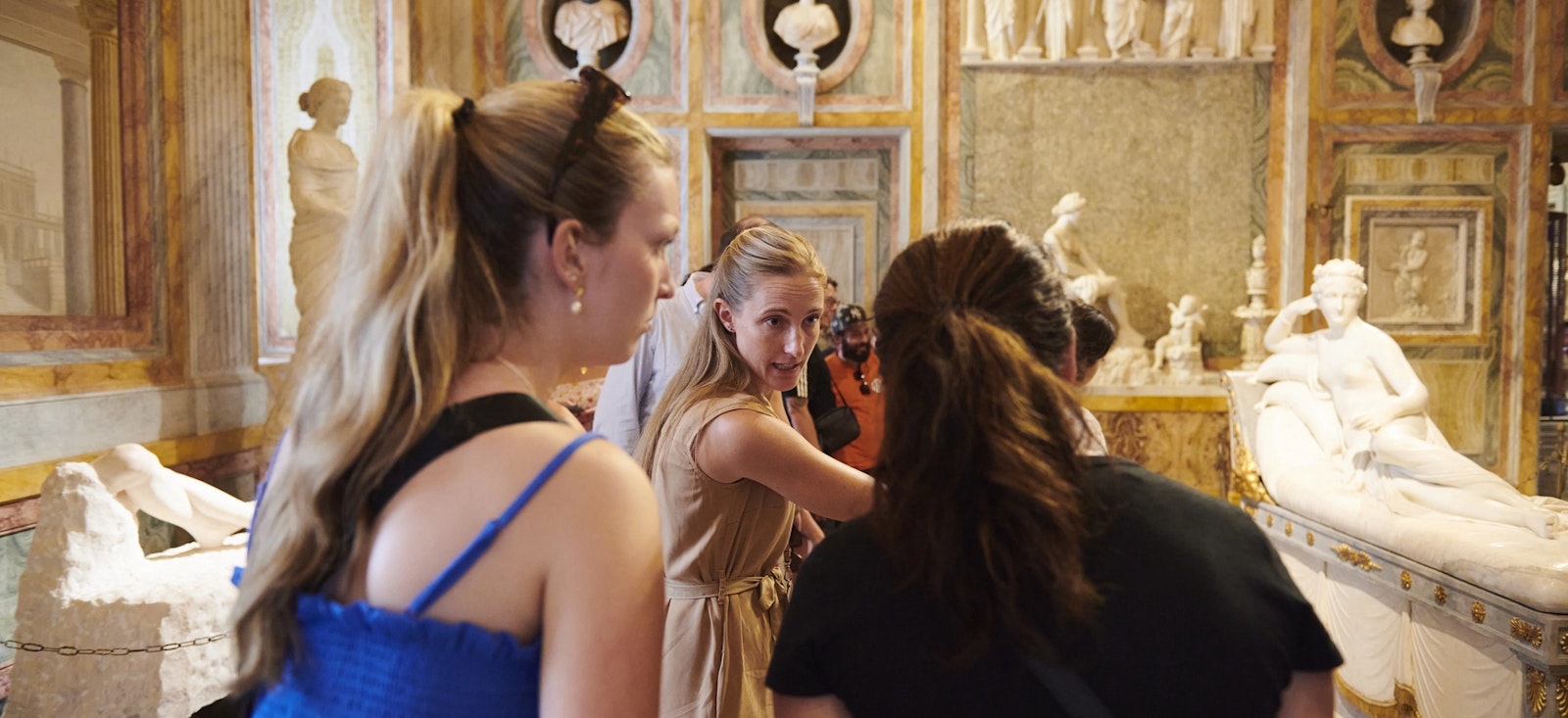
Our Rome private guide Katie, during a Borghese Gallery Private tour, in front of Canova's Paolina Borghese.
Antonio Canova (November 1, 1757), the Italian neoclassical sculptor whose works grace the Borghese Gallery (Borghese Gallery) — his Paolina Borghese as Venus remains one of the most sensual sculptures ever carved.
Marie Curie (November 7, 1867)
Marie Curie (November 7, 1867), the Polish-born physicist who lived and worked in Paris, winning two Nobel Prizes and transforming modern science from her laboratory on the Left Bank.
Sagittarius — The Archer (November 23 – December 21)
The mythology of Sagittarius is tangled — a case of mistaken identity that has lasted over two thousand years.
The constellation depicts a figure aiming a bow at the sky, and most people assume this is Chiron, the wise centaur of Greek mythology. Chiron was unlike other centaurs — where they were brutal and drunken, he was gentle, learned, and civilized. He was the teacher of Achilles, Jason, Heracles, and other heroes. He was skilled in medicine, music, and prophecy. When he was accidentally wounded by one of Heracles' poisoned arrows, his immortality became a curse — he couldn't die, but he couldn't heal. He eventually surrendered his immortality to free Prometheus and was placed among the stars.
But scholars have long noted that Chiron is actually represented by a different constellation — Centaurus, not Sagittarius. The archer in Sagittarius was originally Crotus, a satyr (not a centaur), who was the son of Pan and Eupheme, the nurse of the Muses. Crotus grew up on Mount Helicon among the Muses, and he was the one who invented the bow and arrow. He hunted on horseback, which gave him the appearance of a half-man, half-horse creature, and the Muses adored him for the rhythm he brought to their performances — he is credited with inventing the art of applause.
When Crotus died, the Muses begged Zeus to honor him. Zeus placed him in the sky in the act of drawing his bow — the constellation Sagittarius, the archer forever aiming at the stars.
The confusion between Chiron and Crotus began during the Alexandrian period and was cemented by the Romans, who preferred the nobler Chiron narrative. Two thousand years later, the mixup persists in nearly every astrology book ever printed.
Notable Sagittarians
Gian Lorenzo Bernini (December 7, 1598)
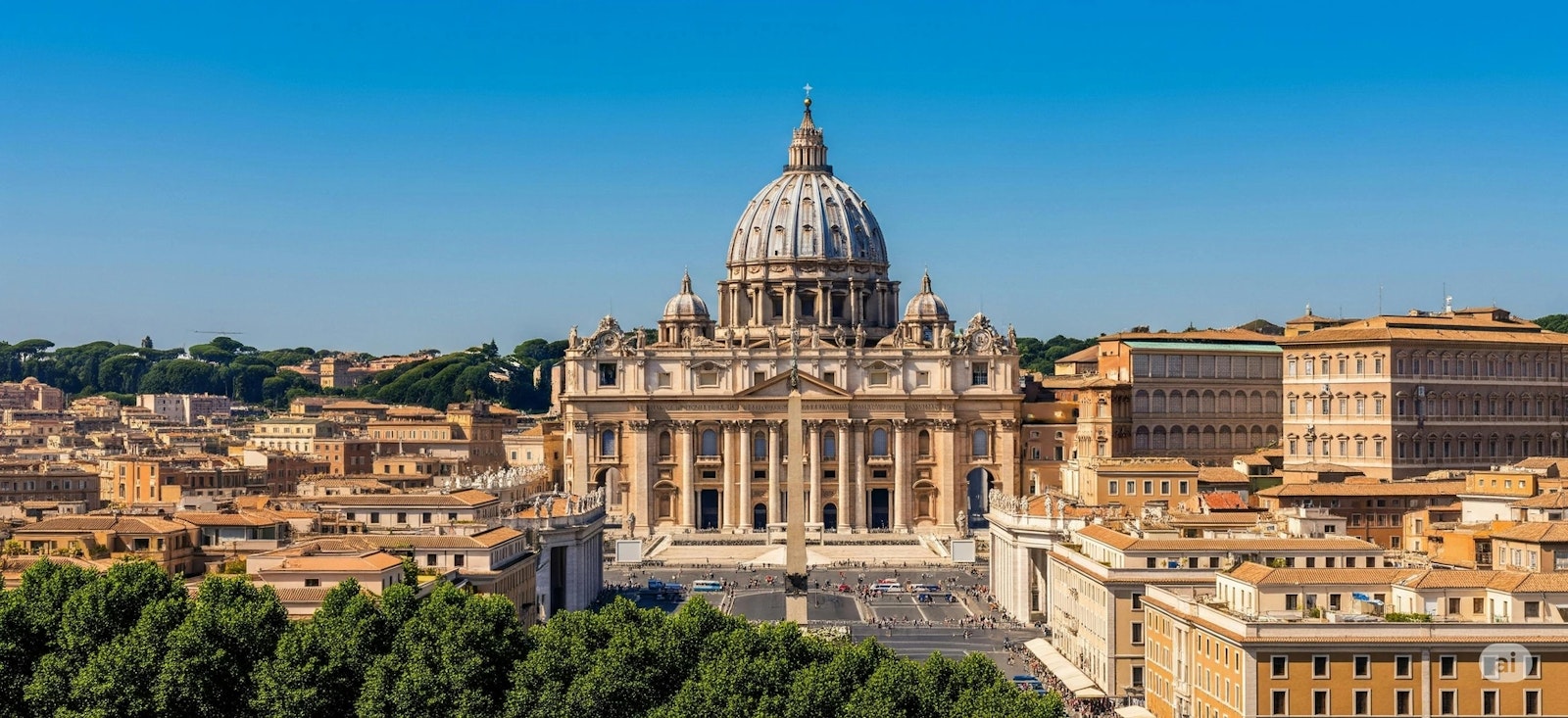
See Bernini's masterpiece with your own eyes during our St. Peter's Basilica Express Private Tour!
Gian Lorenzo Bernini (December 7, 1598), Rome's Baroque genius, whose sculptures animate the Borghese Gallery, whose colonnade embraces St. Peter's Square, and whose fountains define Piazza Navona.
Edith Piaf (December 19, 1915)
Edith Piaf (December 19, 1915), the voice of Paris itself, whose songs still echo through the city's streets and whose grave at Père Lachaise remains one of the most visited in the world.
Capricorn — The Sea-Goat (December 22 – January 19)
Capricorn is one of the oldest figures in the zodiac — a hybrid creature that is half goat, half fish, stretching back to the Babylonians, who worshipped a deity called Ea (or Enki): a sea-goat god who brought civilization, learning, and order to the people of Mesopotamia. Ea lived in the ocean and emerged every day to watch over the land before returning to the depths at night. The image of a creature with a goat's torso and a fish's tail comes directly from this ancient tradition.
The Greeks reinterpreted the sea-goat through the figure of Pan, the god of shepherds, forests, and wild places. Pan was a strange figure — goat-legged, horned, playful, and endlessly lustful. He was the son of Hermes and a forest nymph who abandoned him at birth, repelled by his appearance. Raised by nymphs, Pan spent his life tending flocks, playing his reed pipes, and pursuing nymphs who invariably fled in terror (the word panic derives from his name).
One such nymph, Syrinx, begged the gods to save her from Pan's pursuit. They turned her into a reed. Pan, heartbroken, crafted the reeds into the Pan flute — the syrinx — and played it for the rest of his days.
The constellation comes from a specific episode: during the gods' battle with the monstrous Typhon, Pan tried to escape by transforming into a fish. He only half-succeeded — his lower body became a fish tail while his upper body remained a goat. The result was the sea-goat. Zeus, amused and grateful for Pan's loyalty during the battle, placed the hybrid figure in the stars as Capricorn.
Notable Capricorns
Cicero (January 3, 106 BCE)
Cicero (January 3, 106 BCE), the Roman orator and philosopher whose speeches still define the art of rhetoric — his ghost haunts the Roman Forum where he once held the Republic together with words.
Lorenzo de' Medici (January 1, 1449)

Learn everything you need to know about Medici family during one of our Florence Private Tours!
Lorenzo de' Medici (January 1, 1449), il Magnifico, the Florentine banker and patron whose family shaped the Renaissance and whose legacy fills the Uffizi (Uffizi Gallery), the Medici Chapels, and half of Florence.
Aquarius — The Water Bearer (January 20 – February 18)
The myth of Aquarius is the story of a boy so beautiful that the king of the gods stole him from Earth — and so compassionate that he used his position in heaven to save humanity.
Ganymede was a young prince of Troy, renowned as the most handsome mortal alive. Zeus saw him and wanted him. Disguising himself as an eagle, the god swooped down and carried Ganymede to Mount Olympus, where the boy was given the role of cupbearer to the gods — pouring nectar and ambrosia at divine banquets, carrying a golden cup wherever Zeus traveled.
Hera, Zeus's wife, was furious. She treated Ganymede with open contempt. But Zeus shielded the boy, and Ganymede bore his strange new life with grace.
What elevates the myth beyond a story of divine abduction is what happened next. Ganymede looked down from Olympus and saw the people of Earth suffering from drought — parched fields, dying livestock, desperate thirst. He begged Zeus to allow him to help. After persistent pleading, Zeus relented. Ganymede poured water from the heavens, sending rain down to the earth and quenching the thirst of the people below.
He was deified as Aquarius, the god of rain — the water bearer who carries the vessel of life.
The myth held different meanings for different cultures. For the Greeks and Egyptians, whose lands were frequently parched, Aquarius was a blessing. For the Babylonians, who lived between flood-prone rivers, the water bearer was viewed with more ambiguity.
In Roman culture, the relationship between Zeus and Ganymede was often compared to the real-life bond between Emperor Hadrian and Antinous, the young Greek who was Hadrian's companion and whose death in the Nile devastated the emperor so profoundly that he founded a city in his name and had him deified. The Braschi Antinous in the Vatican Museums (Vatican Museums) and numerous busts across Rome are direct echoes of this story — a mortal made divine through the intensity of another's love.
Notable Aquarians
Emperor Hadrian (January 24, 76 CE)

Did you know Emperor Hadrian built a 120-hectare villa in Tivoli, near Rome? See it during our Tivoli: Villa Adriana and Villa D'Este Private Tour with driver!
Emperor Hadrian (January 24, 76 CE), who built the Pantheon, Castel Sant'Angelo, and a villa in Tivoli so vast it was a city unto itself.
Victor Hugo (February 26, 1802)
Victor Hugo (February 26, 1802), the French titan who wrote Les Misérables and The Hunchback of Notre-Dame, whose words are inseparable from Paris — the city he loved, lost, and immortalized.
Pisces — The Fish (February 19 – March 20)
The myth of Pisces is a story of desperate escape, divine transformation, and a mother's refusal to let go of her child — even when both are turning into fish.
After the Olympian gods defeated the Titans, Gaia — Mother Earth — refused to accept the outcome. From the deepest pit of the Underworld, she coupled with Tartarus and produced Typhon, the most terrifying monster in all of mythology. Hesiod describes him with a hundred dragon heads, flaming eyes, and mouths filled with black tongues. Gaia sent Typhon to destroy the gods on Mount Olympus.
Pan spotted the monster first and warned the other gods, giving them just enough time to transform and flee. Zeus became a ram. Hermes an ibis. Apollo a crow. Diana a cat. Bacchus a goat.
But Venus and her son Cupid were caught off guard, bathing on the banks of the Euphrates River. Typhon was closing in. Venus screamed for help. In one version of the myth, the water nymphs answered her plea, transforming mother and son into fish. In another, two fish appeared from the river and carried them to safety. In both versions, Venus tied their tails together with a cord so they would not be separated in the current.
They swam into the depths and survived. The two fish were placed in the sky as the constellation Pisces — forever bound, forever swimming together.
It's a myth about vulnerability in the face of overwhelming power, and about the bond between parent and child as the last defense when everything else fails. The cord between the two fish is Pisces' most distinctive feature — not just a visual element, but the emotional heart of the story.
Notable Pisces
Michelangelo Buonarroti (March 6, 1475)
Michelangelo Buonarroti (March 6, 1475), the Florentine genius who painted the Sistine Chapel ceiling, carved the Pietà in St. Peter's Basilica, and designed the dome that still defines Rome's skyline.
Sandro Botticelli (March 1, 1445)

See Botticelli's masterpiece during our Uffizi Gallery Early Morning Private Tour!
Sandro Botticelli (March 1, 1445), whose Birth of Venus and Primavera in the Uffizi are among the most iconic images of the Renaissance — beauty rendered with a delicacy that feels almost otherworldly.
Written in the Sky, Carved in Stone
The zodiac is one of humanity's oldest shared stories. Before religion as we know it, before philosophy, before written law, people looked up and saw patterns in the darkness — and they filled those patterns with the things that mattered most: love, death, loyalty, punishment, transformation, and the hope that something of us might endure beyond this life.
Walk through the Vatican Museums and you'll find zodiac imagery in mosaics, frescoes, and ceiling decorations. Visit Pompeii and see astrological motifs in the homes of citizens who believed the stars governed their fate. Stand in the Pantheon and look up through the oculus — the open eye to the sky — and you're standing in the same light that Roman astrologers used to read the heavens.
The myths change depending on who tells them. The stars don't. They're still there, tracing the same arcs they traced when Jason sailed for the Golden Fleece, when Hercules strangled the lion, when Venus tied herself to her son and swam for her life.
Your sign is up there. And now you know the story behind it.