Principles of Heraldry
Every fountain, church, and palazzo in Rome carries a hidden signature. A guide to reading the coats of arms that tell the city's real story of power.





Heraldry in Rome: How to Read the City's Hidden Coat of Arms
Look up in Rome. Not at the sky — at the buildings. Above doorways, carved into fountains, embedded in church facades, mounted on bridges. Everywhere you turn, there's a coat of arms staring back at you. Bees, dragons, oak trees, bulls, stars, mountains, keys. Rome is covered in them, and most visitors walk past without a second glance.
That's a shame, because once you learn to read heraldry, Rome becomes an entirely different city. Every symbol tells you who built what, who paid for it, who held power when the stone was carved. It's like a signature hidden in plain sight — and the city is full of them.
Want to see the most famous coat of arms in Rome? Check our Rome Private Tours and find the one that suits you the best!
How Heraldry Arrived in Rome
The laws of heraldry were formally established in Italy toward the end of the 13th century, though the practice of identifying families and institutions through visual symbols is far older. Initially, coats of arms belonged exclusively to noble families and cities — markers of lineage, territory, and allegiance. Over time, they expanded to include personal symbols: popes, cardinals, knights, and civic officials all adopted their own crests.
The first pope to bear an official coat of arms was Pope Honorius III Savelli, in 1220. Earlier papal coats of arms do exist, but they were added retroactively, sometimes centuries later. The coat of arms attributed to Innocent III Conti, for instance, was only created around 1700, when a relative of his ascended to the papacy and wanted to formalize the family's heraldic lineage.
This is a crucial detail: in Rome, heraldry isn't just decorative. It's political. Every crest placed on a building was a claim of ownership, a display of patronage, a statement that this family, this pope, this cardinal made this happen.
Did you know that most of the Popes during the Middle Ages were nobles? Find out more and book a Vatican Museums, Sistine Chapel, St. Peter's Basilica, and Castel Sant'Angelo Private Tour!
Anatomy of a Crest
A heraldic shield — the central element of any coat of arms — is divided into three horizontal sections, each carrying a specific meaning.
The head (top) typically displays the symbol of the power that granted the title: the papal keys, the imperial eagle, or the emblem of a ruling dynasty. The heart (center) holds the family's own symbol — its most personal identifier. Between head and heart, a smaller element called the place of honor sometimes appears, representing a privilege or distinction conferred by a higher authority. The foot (bottom) may carry the symbol of an institution, administration, or territory over which the family exercised power.
Understanding this structure transforms a walk through Rome. That crest above a palazzo entrance? It's not just an ornament — it's a compressed biography.
Shapes That Tell a Story
The shape of the shield itself carries meaning. A horse-head shield was used by the Holy See. An oval was reserved for women and, notably, for popes — a convention that surprises many visitors. The classic pointed shield dominated the 1500s and early 1600s, while jagged, ornate edges are unmistakably Baroque, placing a crest firmly in the 17th century. The English shield shape — flat-topped and squared — appears in Rome only on the most ancient coats of arms, such as that of Boniface VIII.
Even without knowing the family, you can roughly date a building just by looking at the shape of its heraldic shield. The stonework tells the century.
The Language of Colors
Heraldic colors follow strict rules. Only two metals — gold and silver — and five colors — red, blue, black, green, and purple — are permitted. Green and purple were later additions. When you see yellow and white on a crest (as on the Vatican flag), they represent gold and silver, respectively. Natural objects — animals, trees, fruits — may appear in their own realistic colors, but the background and divisions of the shield follow the code precisely.
Rome's Most Famous Coats of Arms
This is where heraldry becomes a treasure hunt. Once you know what to look for, you'll spot these families everywhere.
The Barberini Bees
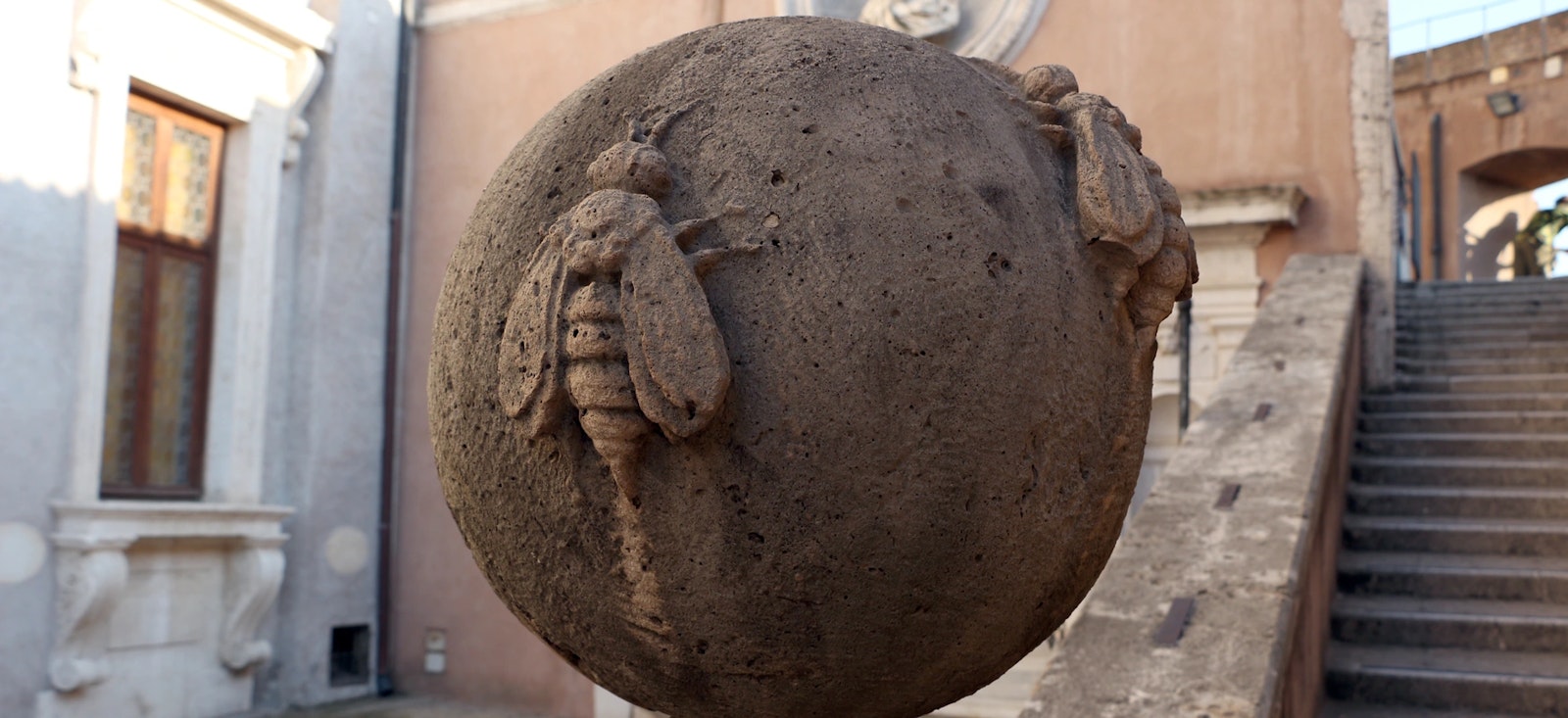
The Barberini bees are perhaps the most ubiquitous. When Cardinal Maffeo Barberini became Pope Urban VIII in the 17th century, his family's three golden bees appeared on everything he touched — and he touched a lot. You'll find them on the canopy of Bernini's Baldacchino inside St. Peter's Basilica (St. Peter's Basilica), on the Fontana delle Api near Piazza Barberini (Piazza Barberini), and across the ceiling of Palazzo Barberini (Palazzo Barberini). A fun detail: the family's original name was Tafani, meaning horsefly. They rebranded to bees — a more dignified insect with associations to Christ — before their rise to power.
With our St. Peter's Basilica Private Tour, you get to see St. Peter's Basilica only, without spending hours inside the Vatican Museums, and by skipping lines.
Della Rovere Oak Tree
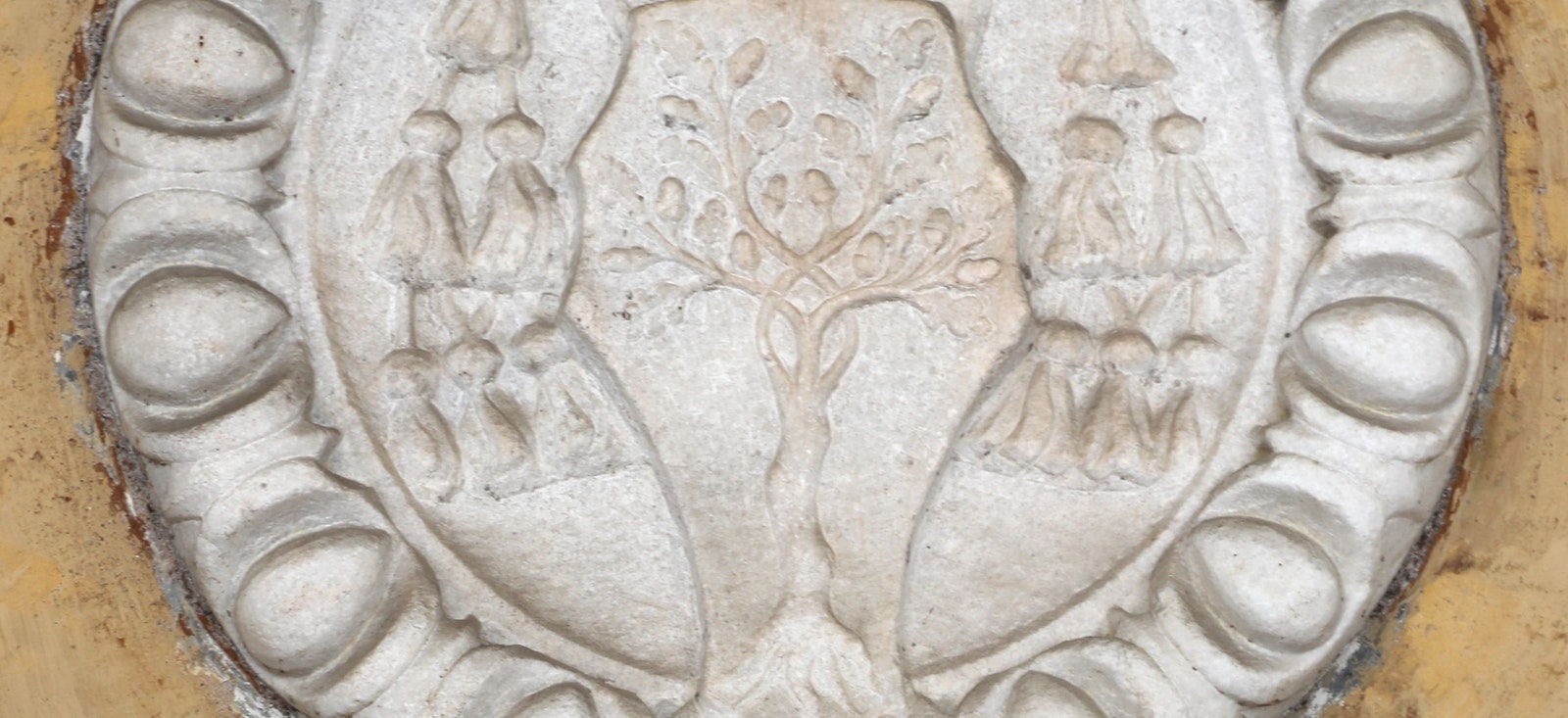
The Della Rovere oak tree marks the papacy of Julius II, the warrior pope who commissioned Michelangelo's Sistine Chapel ceiling. Rovere means oak in Italian, and the family's tree appears carved into churches and palazzi across Rome and central Italy.
Borgia Bull

The Borgia bull — the red bull of Pope Alexander VI — carries the weight of one of Rome's most controversial pontificates. You'll spot it at the Vatican Museums, especially in the Borgia Apartments with their lavish frescoes by Pinturicchio.
Boncompagni Dragon

The Boncompagni dragon belongs to Pope Gregory XIII, the man who gave us the Gregorian calendar. His winged dragon appears on monuments throughout Rome, including the Tower of the Winds inside the Vatican.
Borghese Eagle and Dragon

The Borghese Arms of Coats at St. Peter's Basilica. Book a St. Peter's Basilica Express Private Tourto see it with your own eyes.
The Borghese eagle and dragon — combined into a single crest — mark the legacy of Pope Paul V and the powerful Borghese family. Look for them at the Borghese Gallery and on the facade of St. Peter's Basilica itself, where Paul V's name is inscribed in enormous letters.
Chigi Mountains
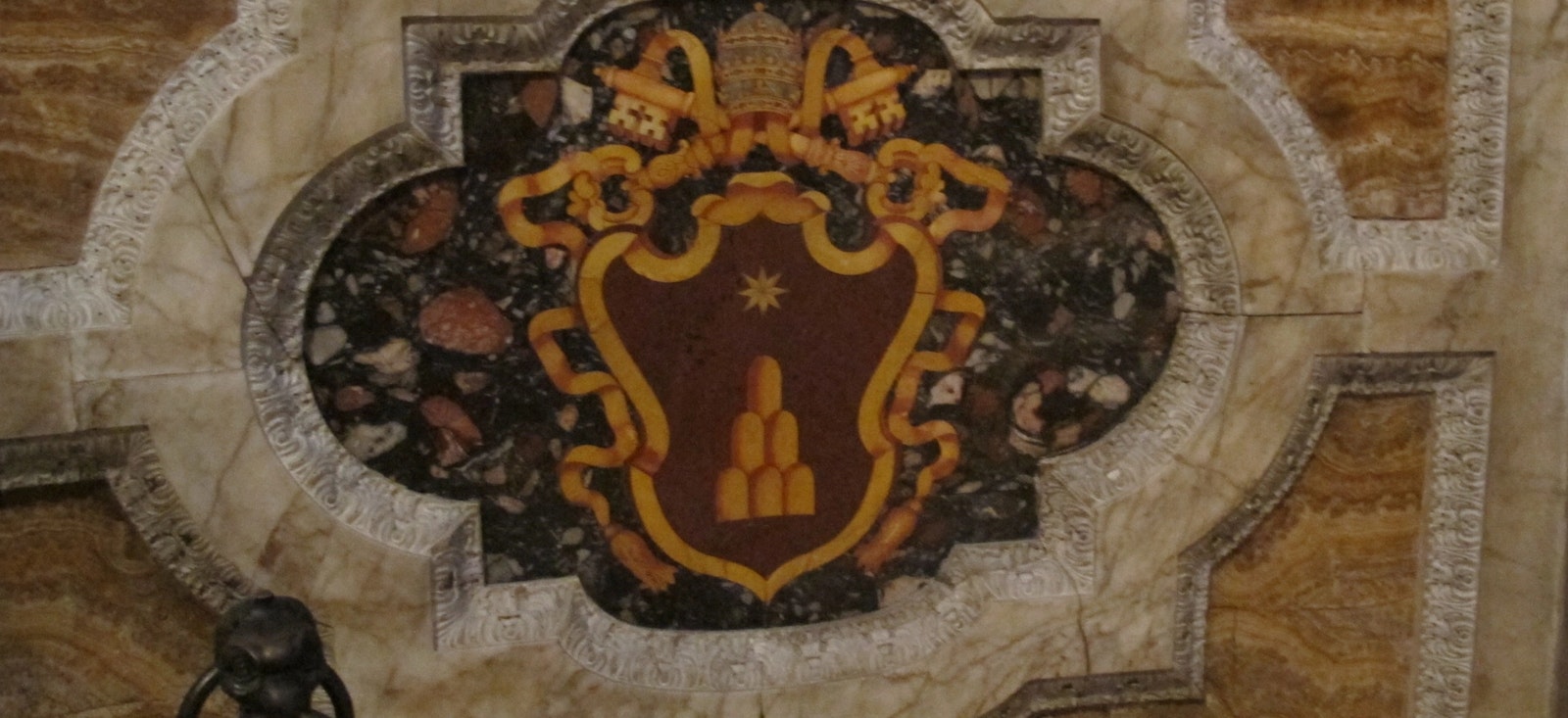
The Chigi mountains and star identify the banking dynasty that shaped Renaissance Rome. Agostino Chigi commissioned Raphael to decorate his villa — now the Villa Farnesina — and the family's six-pointed star appears on churches and chapels across the city, including the famous Chigi Chapel in Santa Maria del Popolo.
Marriage, Adoption, and the Shield
Heraldic shields also encode family relationships. A shield divided vertically — called a party emblem — signals a marriage between two people of equal nobility: the husband's symbol on the right (viewer's left), the wife's on the left. A horizontal division indicates a marriage between nobles of different rank, with the higher title on top.
A shield quartered into four represents a union other than marriage — typically an adoption. The most famous Roman example is the crest of Agostino Chigi, who was adopted by Julius II and whose coat of arms blends the Chigi star with the Della Rovere oak.
A sliced shield — divided diagonally — indicates acquired kinship, such as in-laws. It wasn't automatic; families chose to display it as a matter of prestige.
A City Written in Stone
Walking through Rome with even a basic understanding of heraldry changes the experience entirely. That bee on a fountain in Trastevere? Barberini money. That oak tree above a church door near Piazza Navona? Julius II's patronage. That dragon on a wall in the Borgo? Gregory XIII was here.
The city is a palimpsest of power, and the coats of arms are the signatures. Every pope who built, every family who paid, every cardinal who competed for glory left their mark in stone — and it's all still there, waiting for someone to look up and read it.
Rome's a city shaped by noble families, leaving plenty of symbols throughout the city over the centuries.
Book a Rome Private Tour to find them all (or most of them!)