Pizza in Italy: Choosing "Alta" (Deep Pan) or "Bassa" (Thin Crust)?
Naples folds it. Rome cuts it. One uses only four ingredients, the other adds olive oil. A guide to choosing sides in Italy's most delicious argument.





Pizza in Italy: Alta or Bassa? The Great Italian Pizza Debate
If you think ordering pizza in Italy is simple, you haven't been to Italy yet.
Back home, pizza is pizza. You pick your toppings, it arrives, and you eat it. In Italy, pizza is an identity. It's a regional allegiance, a family tradition, a philosophical position defended with the same intensity that other countries reserve for politics or religion. Ask a Roman and a Neapolitan which pizza is better, and you won't get a polite answer — you'll get a debate that can last the entire evening, fueled by wine and gesticulation.
The argument comes down to one fundamental question: alta or bassa? Thick or thin? Deep pan or thin crust? Naples or Rome? And the answer, as with most things in Italy, is far more complicated — and far more delicious — than it sounds.
Would you like to learn how to make pizza while in Rome?
Book our Private Roman Pizza Making with a real local Pizzaiolo!
Two Cities, Two Philosophies
The roots of Italy's pizza divide run deeper than dough. They're cultural, historical, and almost tribal. Every one of Italy's twenty regions claims to make the best pizza in the country, but the real rivalry has always been between two cities: Naples and Rome.
Naples is the birthplace of modern pizza. The story most Italians know — whether or not it's entirely true — is that in 1889, a Neapolitan pizzaiolo named Raffaele Esposito created a pizza topped with tomato, mozzarella, and basil to honor Queen Margherita of Italy. The colors matched the Italian flag. The queen loved it. The pizza Margherita was born, and Naples claimed its throne.
But pizza's ancestry stretches back far further. The Latin word pinsere — to knead — gave rise to the ancient Roman pinsa, a flatbread topped with herbs, cheese, or honey, offered to the gods by priests. Flatbreads baked in wood-fired ovens have been found at archaeological sites across Italy, including Pompeii, where a recently discovered fresco caused a stir by depicting what looked remarkably like a modern pizza — in the first century CE.
Rome and Naples both inherited the tradition. What they did with it split into two entirely different directions.
Pizza Napoletana: The Soft, Pillowy Queen

Neapolitan pizza is soft, chewy, and unapologetically thick at the edges. The cornicione — the puffy, slightly charred border — is the signature. It rises high, trapping air during a long fermentation process that can last 24 hours or more. The center is thin, almost wet, yielding under the weight of its toppings. Pick up a slice and it droops — what Italians call the calzone effect — urging you to fold it in half like a wallet (a portafoglio) and eat it with your hands.
The dough is made from just four ingredients: flour, water, salt, and yeast. No oil. No fat. Nothing else. This simplicity is sacred — and legally protected. Pizza Napoletana holds UNESCO recognition as an Intangible Cultural Heritage, and the Associazione Verace Pizza Napoletana (AVPN) maintains strict rules governing everything from fermentation time to oven temperature.
And about that oven: a true Neapolitan pizza is baked in a wood-fired oven at temperatures between 450 and 500°C for just 60 to 90 seconds. The result is a crust that's soft and elastic on the inside, with those distinctive dark spots — the leopard spots — charred onto the cornicione by the furnace's ferocious heat.
Classic toppings are minimal. San Marzano tomatoes, fior di latte or buffalo mozzarella, fresh basil, a drizzle of extra virgin olive oil. The pizza Margherita and the pizza Marinara (tomato, garlic, oregano, oil — no cheese) are the two canonical forms. Anything more is considered, by Neapolitan purists, an unnecessary distraction from perfection.
Pizza Romana: The Thin, Crispy Rebel

Roman pizza plays by different rules. Where Naples wants softness, Rome demands crunch.
The dough contains olive oil, which is the key distinction. The oil allows the dough to be stretched thinner, rolled out wider, and baked into a base that snaps when you bite into it. The edges are almost flat — there's no cornicione to speak of. The crust is uniformly thin across the entire surface, giving the pizza a disc-like appearance that often exceeds the edges of the plate.
Roman pizza bakes at a lower temperature — around 300 to 350°C — for a longer time, which dries out the dough and produces that characteristic crispiness. The result is a pizza you can hear: it crackles under the knife, splinters at the edges, and delivers a textural experience that's the polar opposite of Naples.
Because the base is thinner, a pizza romana can hold more toppings — and Romans take full advantage. The flavor of each ingredient comes through more clearly, unobstructed by excessive bread. Fresh tomato tastes brighter. Mozzarella melts thinner and develops more contrast against the crispy base. Olive oil pools in little pockets instead of being absorbed.
But there's a trade-off: Roman pizza is harder to eat with your hands. The thin base buckles under the weight of its toppings. Most Romans use a fork and knife — a fact that surprises many visitors who assume pizza is always finger food. In Naples, you fold and eat. In Rome, you cut and eat. The tools define the culture.
Pizza al Taglio: Rome's Street-Food Revolution
Rome also gave the world pizza al taglio — pizza by the slice. Rectangular, baked in large pans, sold by weight, and cut with scissors. It's the city's most democratic food: available on virtually every corner, affordable for everyone, and endlessly customizable.
The best pizza al taglio shops — and there are hundreds in Rome — offer dozens of varieties on display: pizza rossa (just tomato sauce), pizza bianca (plain with oil and salt), pizza con patate (thin potato slices and rosemary), and creative seasonal toppings that change daily. You point, they cut, they weigh, you eat. It's Roman efficiency applied to Italian indulgence.
Walk through Trastevere, the Jewish Quarter, or the streets around Campo de' Fiori and you'll pass a dozen pizza al taglio counters without trying. Each one has its loyalists. Each one is convinced it's the best. They're probably all right.
Learn how to make Pizza!
Have you ever wondered why your pizzas are never like those you see in the photos?
That's not your fault! You probably haven't had a good teacher.
Book a private Pizza Class in Rome, a become a master pizzaiolo!
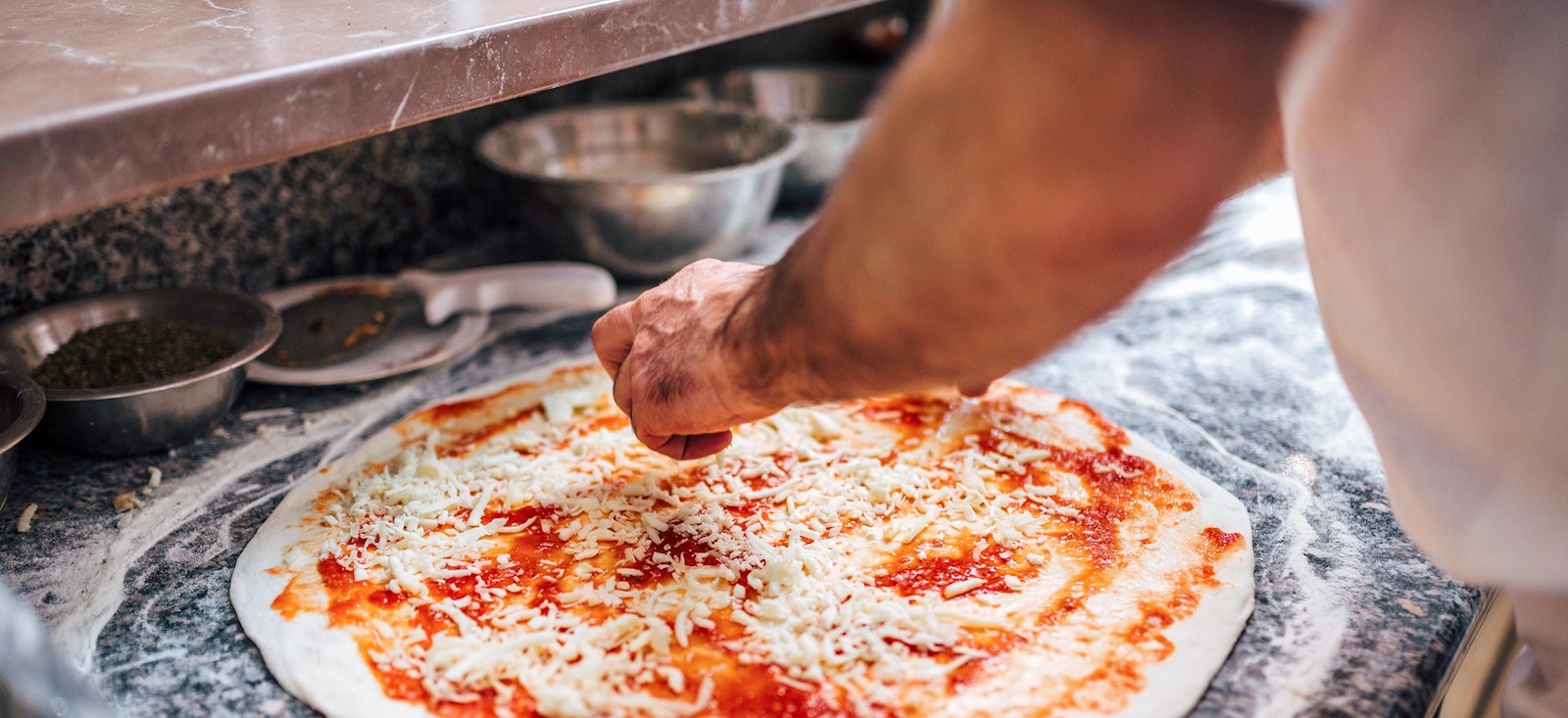
What You Won't Find on an Italian Pizza
Here's where first-time visitors need to recalibrate their expectations. Italian pizza menus are shorter than you think — and certain toppings that are standard abroad simply don't exist in Italy.
Toppings you will find everywhere: buffalo mozzarella, prosciutto crudo, artichokes, olives, porcini mushrooms, zucchini flowers (fiori di zucca), anchovies, and spicy salami (salame piccante, which is what Italians mean when someone abroad orders "pepperoni").
Toppings you won't find — or will find only in tourist traps: pineapple (this is non-negotiable), sweetcorn, green peppers, jalapeños, bacon (in the American sense), and onions as a primary topping. The Hawaiian pizza doesn't exist in Italy. Mentioning it in Naples may result in a lecture. Mentioning it in Rome will get you a look.
Italian pizza is about restraint. Three or four high-quality ingredients on a well-made base. The dough does the work. The toppings accent it. The moment a pizza is overloaded, the balance is lost — and balance is what separates Italian pizza from everything that calls itself pizza elsewhere in the world.
So, Alta or Bassa?
This is not a question anyone can answer for you. It's a question Italy has been arguing about for generations, and nobody has won yet.
If you love bread, if you want to fold your pizza and eat it standing on a Neapolitan street corner, if you want softness and simplicity and the taste of dough that's had a full day to develop its flavor — you're a pizza alta person. Head to Naples (Naples, Pompeii & Amalfi Coast).
If you love crunch, if you want a pizza so wide it hangs off the plate, if you want the toppings to dominate and the base to shatter — you're a pizza bassa person. Stay in Rome.
And if you're smart, you'll try both. Because the only wrong answer in the great Italian pizza debate is not ordering a second one.