Mystery in an Ancient Mosaic
A tropical fruit in a 2,000-year-old mosaic? The mystery of Rome's "pineapple" is stranger — and more satisfying — than you'd expect.





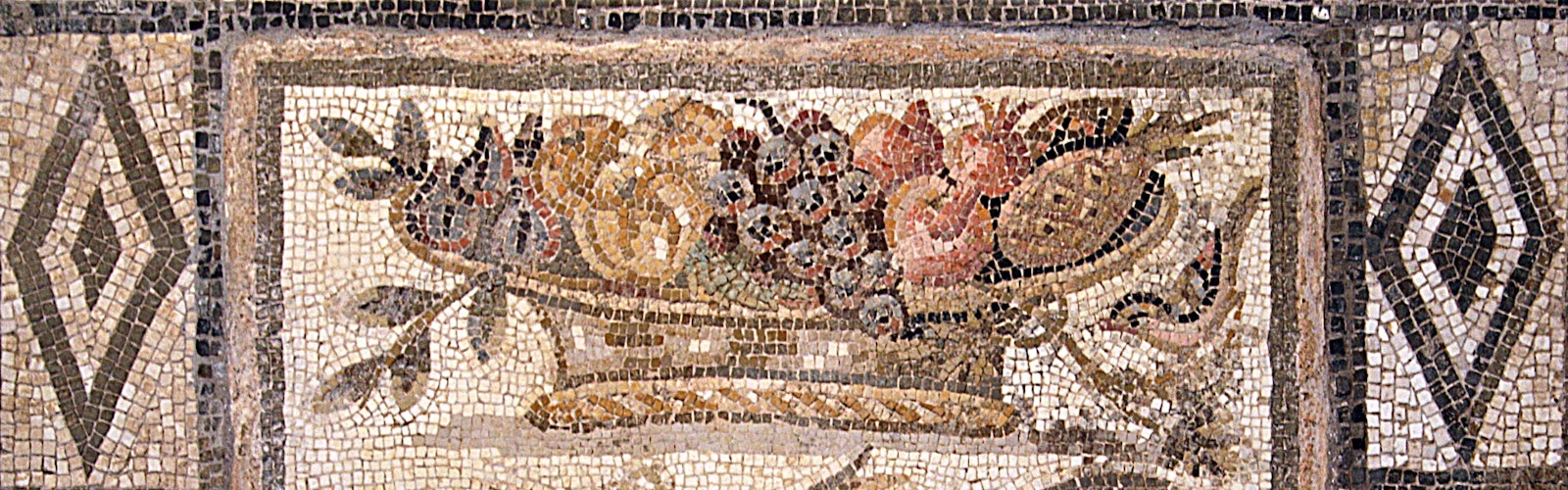
Mystery in an Ancient Mosaic: The Roman "Pineapple" That Shouldn't Exist
On the second floor of Palazzo Massimo alle Terme (Palazzo Massimo), tucked inside the gallery dedicated to ancient Roman frescoes and mosaics, there's a floor mosaic that has quietly unsettled historians for generations.
Dating from the early 1st century CE, the mosaic depicts a generous basket of fruit — figs, grapes, pomegranates, apples. Everything you'd expect from a Mediterranean harvest scene. And then, sitting right there among them, something that looks unmistakably like a pineapple.
The problem? Pineapples are native to South America. They didn't arrive in Europe until Christopher Columbus brought them back from the Caribbean in 1493. So how does a tropical fruit from the Americas end up in a Roman mosaic created fifteen centuries before Columbus set sail?
Curious about what Romans used to eat back in the past? Our "Roman Feasting" blog article got you covered!
Not an Isolated Case
The Palazzo Massimo mosaic isn't the only example. In Pompeii, a fresco discovered in the House of the Ephebe shows a child offering what appears to be a pineapple to the gods. The shape is distinctive — the diamond-patterned skin, the crown of spiky leaves. It's specific enough to make you pause.
These two appearances, separated by geography but united by era, have fueled some of the more creative theories in Roman archaeology. Could ancient Romans have reached the Americas? Was there a secret trade route across the Atlantic? Did some unknown intermediary bring tropical fruits to Mediterranean ports?
The theories are entertaining. The answer, almost certainly, is far more mundane — and far more interesting.
Want to see this mosaic with your own eyes? Check our Private Day Trip from Rome to Pompeii!
The Pinecone Solution
The most widely accepted explanation is that Roman artists were depicting pinecones. And once you understand what pinecones meant to the ancient world, the mystery dissolves into something richer than any transatlantic conspiracy.
The pinecone was one of the most powerful symbols in the ancient Mediterranean. For the Romans, it represented fertility, abundance, and regeneration. It was sacred to multiple cults — associated with Cybele, the mother goddess, and with Dionysus, god of wine and ecstasy. Pinecones decorated temples, fountains, domestic gardens, and funerary monuments. They appeared on the staffs of priests and the finials of sacred objects.
In other words, placing a pinecone in a mosaic fruit basket wasn't random decoration. It was a deliberate symbol — a wish for prosperity, a nod to the divine. Roman artists, in their desire to make these pinecones more visually appealing, added foliage at the top. The result, to modern eyes accustomed to tropical fruit aisles, looks strikingly like a pineapple.
They had no idea they'd be confusing viewers two thousand years later.
The Word Itself Tells the Story
Here's where the mystery loops back on itself in a beautifully satisfying way. The English word "pineapple" was originally coined to describe pinecones — the "apple" (fruit) of the "pine" (tree). It was the standard English term for pinecones for centuries.
When European explorers reached the Americas and encountered the actual tropical fruit, they noticed the visual similarity to pinecones and applied the existing word to the new discovery. The tropical fruit kept the name; the pinecone lost it. In most other European languages, the fruit is called something derived from its indigenous name — ananas in French, Italian, Spanish, German, and Portuguese.
So when we look at a Roman mosaic and see a "pineapple," we're actually seeing the original object the word was invented for. The confusion is entirely linguistic, entirely modern, and entirely our fault.
The Giant Pinecone You Can Still Visit
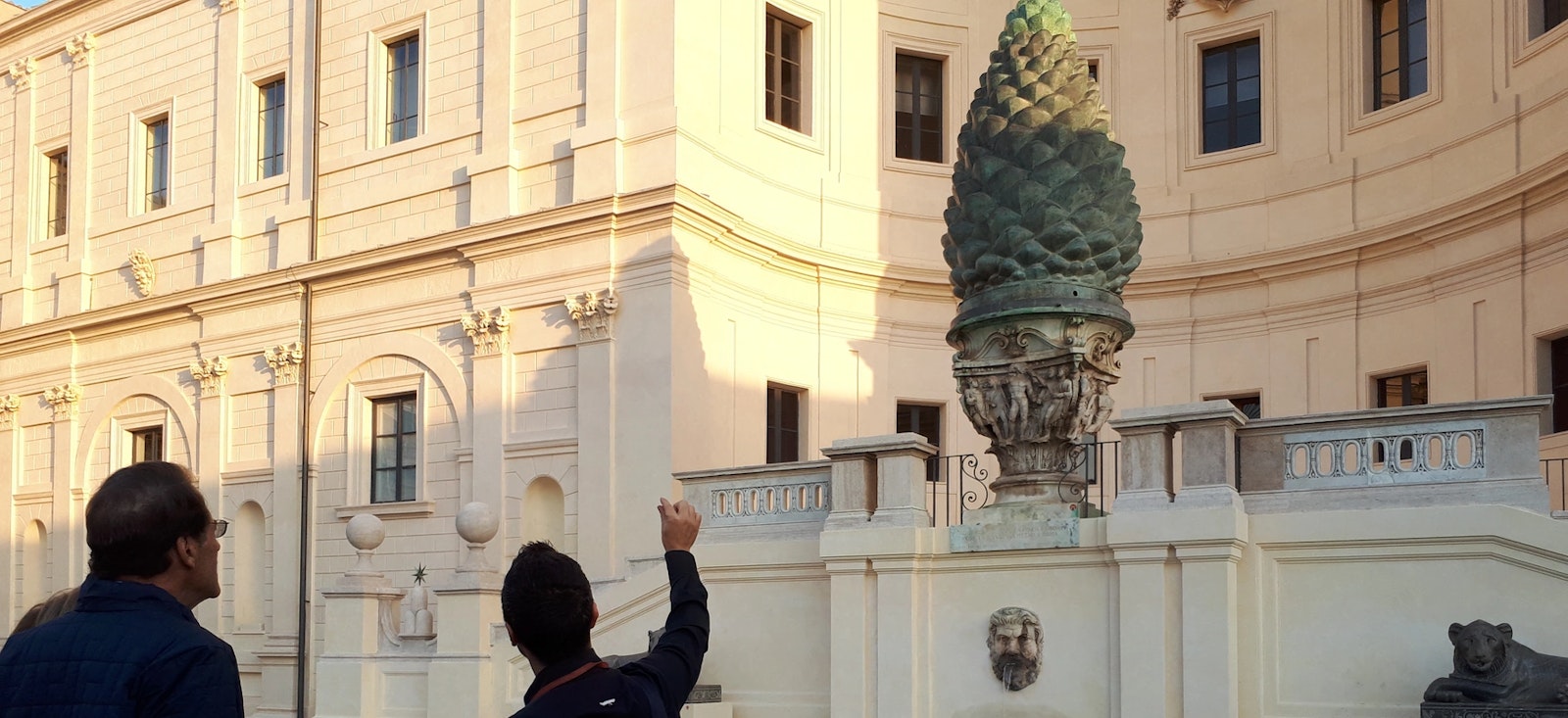
One of our Vatican Museums Private Guides is explaining in the Pinecone Courtyard, during one of our Vatican Museums Private Tours.
If you want to see just how seriously the Romans took their pinecones, check our Vatican Museums Private Tours. In the Cortile della Pigna — the Courtyard of the Pinecone — stands a colossal bronze pine cone nearly four meters tall. It originally functioned as a Roman fountain, spouting water from its tip, and stood near the Pantheon beside the Temple of Isis.
During the Middle Ages it was moved to the courtyard of Old St. Peter's Basilica, and in 1608 it reached its current position, set into a massive niche designed by Pirro Ligorio. It's one of the first things you see when entering the Vatican Museums, flanked by two bronze peacocks and framed by Arnaldo Pomodoro's modern golden sphere.
The Pigna is Rome's largest surviving pinecone — and the most literal proof that this humble seed pod held a place of honor in the ancient world that few other natural objects could rival.
See the Mystery for Yourself
Palazzo Massimo alle Terme sits just steps from Roma Termini station, and it remains one of Rome's most underrated museums. The mosaic galleries on the upper floors — where the mysterious "pineapple" lives — also house some of the finest surviving examples of Roman wall painting, including frescoes from the villa of Livia, Augustus's wife, with garden scenes so vivid they make you forget you're underground.
The pineapple is there, in its basket, between the figs and the pomegranates. You'll see it and you'll understand the confusion instantly. And then you'll smile, because the real story — a pinecone dressed up by an artist who couldn't have imagined a world where his decorative flourish would spark conspiracy theories — is better than any lost trade route could ever be.
Curious about other Rome myths and legends? Book one of our Rome Private Tours!