10 Facts you didn't know about Da Vinci's Last Supper
These facts about Da Vinci's Last Supper reveal a painting that has survived against extraordinary odds, endured deliberate damage and neglect, and continues to challenge our understanding of Renaissance art and Leonardo's revolutionary approach to both technique and narrative.





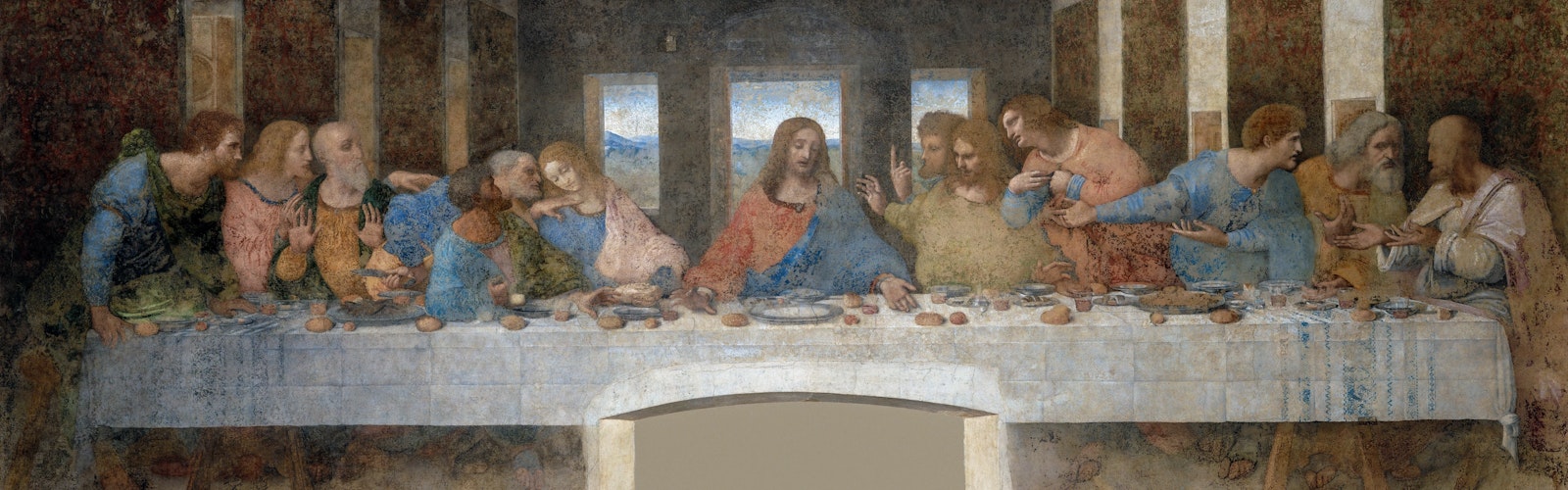
Leonardo da Vinci's "Last Supper" ranks among the world's most recognized paintings, yet its fame often obscures the remarkable—and sometimes troubling—story behind its creation and survival. Painted on the wall of a Milan refectory between 1495 and 1498, the work represents both Leonardo's genius and his willingness to experiment in ways that nearly destroyed his masterpiece.
These facts about Da Vinci's Last Supper reveal a painting that has survived against extraordinary odds, endured deliberate damage and neglect, and continues to challenge our understanding of Renaissance art and Leonardo's revolutionary approach to both technique and narrative.
Want to know more from an official private tour guide? Check our Da Vinci's Last Supper Private Tours.
Leonardo's Experimental Technique Failed Almost Immediately
Most visitors assume they're looking at a fresco, but Leonardo deliberately rejected the traditional fresco technique that would have required him to work quickly on wet plaster. He wanted the subtle gradations of light and shadow that characterized his oil painting style—effects impossible to achieve with fresco's speed requirements.
Instead, Leonardo prepared the wall with an experimental mixture of gesso, glue, and tempera applied to dry plaster. The technique allowed him to work slowly, revising and refining as he painted. The results were visually stunning but structurally disastrous. By 1517, barely twenty years after completion, paint was already flaking away from the wall.
This technical failure explains why the Last Supper has required constant intervention throughout its history. Restoration experts describe it as "a miracle of survival"—a masterpiece that by all rights should have disappeared centuries ago but persists through continuous conservation efforts.
The Opposite Wall Contains a Forgotten Masterpiece
While millions focus on Leonardo's work, the wall directly opposite contains a massive fresco by Giovanni Donato da Montorfano that almost no one notices. Painted a few years before the Last Supper and executed in traditional fresco technique, Montorfano's "Crucifixion" remains in far better condition than Leonardo's experimental work.
What makes this particularly significant is that Leonardo actually painted additional figures in oil directly onto Montorfano's fresco—an early experiment in combining techniques. These additions have almost entirely disappeared, but their existence proves Leonardo was testing his mixed-media approach on someone else's work before applying it to his own major commission.
The contrast between the two walls provides an unintentional lesson in Renaissance painting techniques: Montorfano's conventional fresco survived intact while Leonardo's innovation nearly self-destructed.
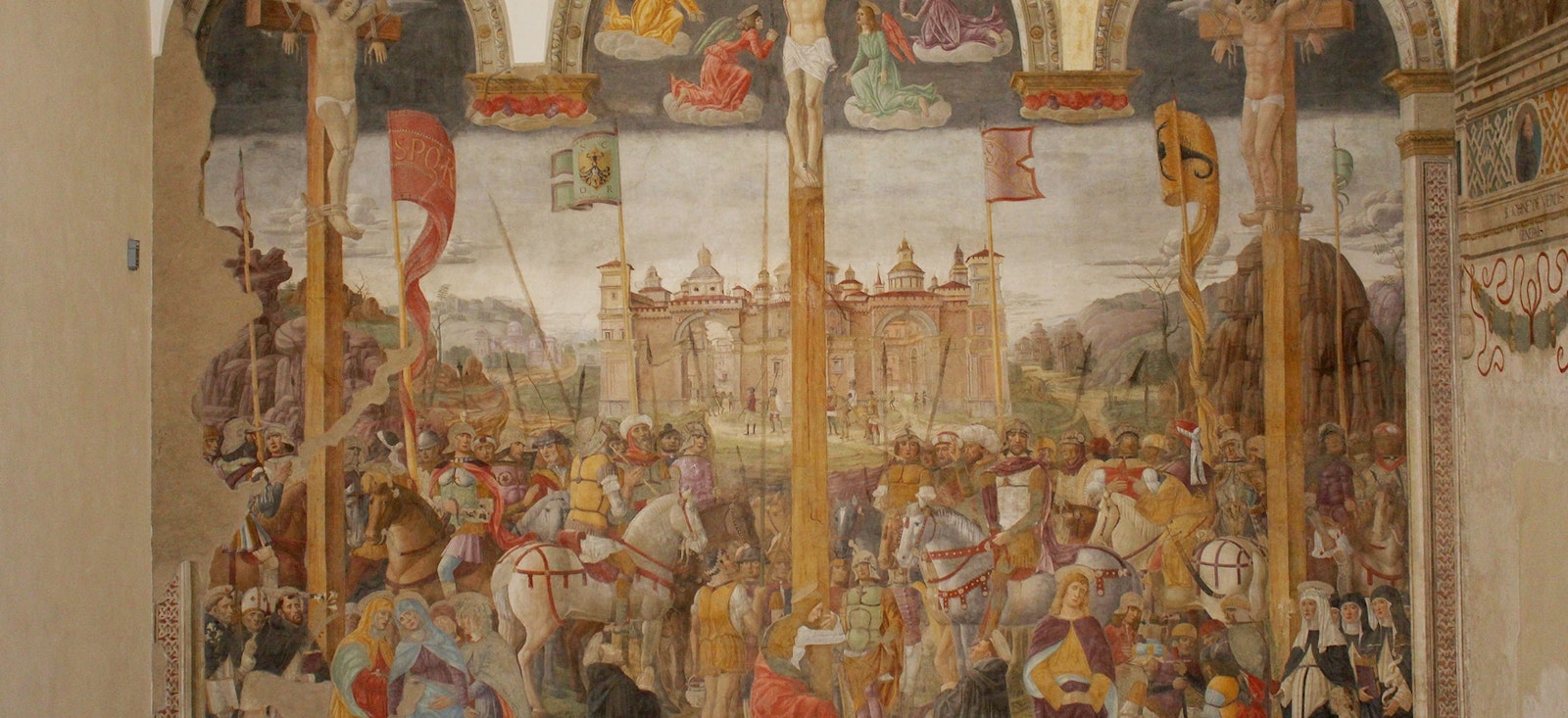
Montorfano's fresco inside the Cenacolo Vinciano
A Doorway Literally Cut Through the Painting
In the 17th century, monks decided they needed better access between the refectory and the kitchen. Their solution? Cut a doorway through the wall directly beneath the painting's center, removing Christ's feet and part of the table.
The architectural logic made practical sense, but the artistic loss was catastrophic. The door was eventually sealed, but the damage remains permanent. The empty space beneath Christ that appears in every photograph isn't Leonardo's compositional choice—it's the result of this historical vandalism.
This mutilation stands as one of art history's most frustrating moments of practical necessity overriding cultural preservation, made worse by the fact that the monks who authorized it would have understood the painting's significance.
Thirteen Different Perspectives Converge on Christ's Head
The painting's central perspective point famously aligns with Christ's head, but Leonardo constructed the entire architectural space using thirteen distinct perspective systems—one for each figure at the table. This wasn't an error but a deliberate theatrical effect.
Leonardo designed these multiple perspectives to create optimal viewing from the specific location where monks would sit during meals. The painted room isn't architecturally "realistic"—it's a carefully engineered illusion designed to appear perfect from one particular vantage point in the actual refectory.
This represents one of the most complex perspective experiments ever attempted in mural painting, demonstrating Leonardo's interest in how mathematical principles could serve dramatic and spiritual purposes.
Planning a holiday in Milan?
Are you planning a trip to Milan? Willing to get the best from it?
Click the button and book a Milan private tour!

Christ's Face Contains Multiple Layers of Revision
Leonardo struggled intensely with Christ's face. Contemporary accounts describe him climbing the scaffolding repeatedly to make minute adjustments to shadows and expressions, never quite satisfied with the result. Art historians believe the face contains at least three distinct layers of revision, each painted over the previous attempt.
This constant reworking contributed to the face's almost ethereal quality—it appears softer and less defined than other figures in the composition. No other representation of Christ in Renaissance art underwent such extensive revision, making this face unique in both its creation process and its final effect.
The technical examination during modern restoration revealed these layers, showing how Leonardo's perfectionism led him to continuously modify what he'd already painted, even as he understood that his experimental technique made such revisions problematic for long-term preservation.
Napoleon's Troops Used the Refectory as a Stable
When French forces occupied Milan in 1796, they converted the refectory into a stable, stabling horses directly beneath Leonardo's masterpiece. Soldiers reportedly threw stones at the painting for entertainment, and a French general's diary describes it as "almost illegible" due to deterioration and deliberate damage.
This period of neglect accelerated the painting's decay significantly. The combination of humidity from the animals, physical abuse, and complete disregard for the artwork's significance brought it closer to destruction than any previous event in its history.
That the painting survived this treatment at all seems remarkable. The fact that it remained visible enough for eventual restoration borders on miraculous, given the conditions it endured during the French occupation.
Are you planning a Euro-trip and want to know more secret facts?
Check our 10 facts you didn't know about Paris article!
Sandbags Saved the Painting from World War II Bombs
During World War II, Milan faced heavy Allied bombing that destroyed much of the Santa Maria delle Grazie complex. Anticipating this danger, workers constructed an elaborate protective system around the Last Supper wall using wooden braces and thousands of sandbags.
When bombs hit the refectory in 1943, the building around the painting collapsed, but the reinforced wall remained standing. For months afterward, Leonardo's work sat exposed to open air, protected only by the sandbag structure while the building lay in ruins around it.
Without this emergency preservation effort, the Last Supper simply wouldn't exist today. The protection system represented one of World War II's successful cultural preservation initiatives, born from the understanding that some artworks justify extraordinary measures for their survival.
Need more facts?
Want to know more facts about Da Vinci's Last Supper?
Book our Last Supper Early Morning Private Tour and be the first to access the Cenacolo on that day!

Modern Restoration Revealed That Most of the Surface Isn't Original
The comprehensive restoration from 1978 to 1999 lasted twenty-one years and fundamentally changed our understanding of the painting's condition. Scientific analysis showed that more than 60 percent of the visible surface no longer contains Leonardo's original paint.
Rather than repaint missing sections, restoration experts used a technique of subtle neutral-toned hatching—visible up close but invisible from viewing distance. What visitors see today represents a careful balance between surviving original passages, historic repainting from previous restoration attempts, and modern scientific reconstruction.
This makes the Last Supper one of art history's most extensively "reconstructed" works, raising complex questions about authenticity and preservation. The painting we experience today is partly Leonardo's creation, partly the work of generations of restorers attempting to preserve what remains and reconstruct what was lost.
Judas's Distorted Perspective Signals His Moral Separation
Leonardo broke with tradition by seating Judas on the same side of the table as the other apostles rather than isolating him across from them. This made the composition more unified but required subtle methods to distinguish the betrayer.
Leonardo achieved this through barely perceptible perspective distortion in Judas's hands and posture. While the other figures follow the painting's complex but consistent spatial logic, Judas's body occupies a slightly different geometric system—as if he exists partially outside the shared space of the other apostles.
This represents incredibly sophisticated visual symbolism, using mathematical principles to communicate moral separation in a way that registers subconsciously rather than obviously. It's the kind of detail that demonstrates Leonardo's interest in using scientific knowledge for psychological and spiritual expression.
The Painting Captures a Single Dramatic Instant
Unlike earlier Last Supper representations showing a calm meal, Leonardo chose the specific moment when Christ announces "One of you will betray me." The apostles' reactions to this shocking statement drive the entire composition's dramatic energy.
Each group of three figures responds differently—some with disbelief, others with anger, confusion, fear, or sorrow. Leonardo studied these emotional responses through dozens of preparatory drawings, analyzing how different personalities would physically express psychological states.
This represents the first fully documented example of "psychological choreography" in Western painting—a composition built entirely around the theatrical representation of emotional response to a dramatic revelation. Leonardo wasn't just painting a biblical scene; he was staging a moment of crisis and capturing twelve distinct reactions to betrayal announced by someone they loved and trusted.
Conclusion
The Last Supper's fame sometimes obscures how improbable its survival has been. Between Leonardo's failed experimental technique, deliberate vandalism, use as a stable, wartime bombing, and centuries of deterioration, the painting has faced nearly every threat art can encounter.
What remains today is partly Leonardo's original work, partly the efforts of generations of restorers, and partly the result of emergency measures taken during wartime. Understanding these facts doesn't diminish the painting's power—it makes Leonardo's achievement even more remarkable and highlights the extraordinary efforts required to preserve cultural masterpieces across centuries.
The next time you see a reproduction of the Last Supper or visit the refectory in Milan, you'll know you're looking at not just a Renaissance masterpiece, but a work that has survived against remarkable odds through a combination of artistic genius, historical accident, and dedicated preservation efforts spanning more than five centuries.
Want to know more about Da Vinci's Last Supper and Milan?
Check our Milan private tours and get instant confirmation!